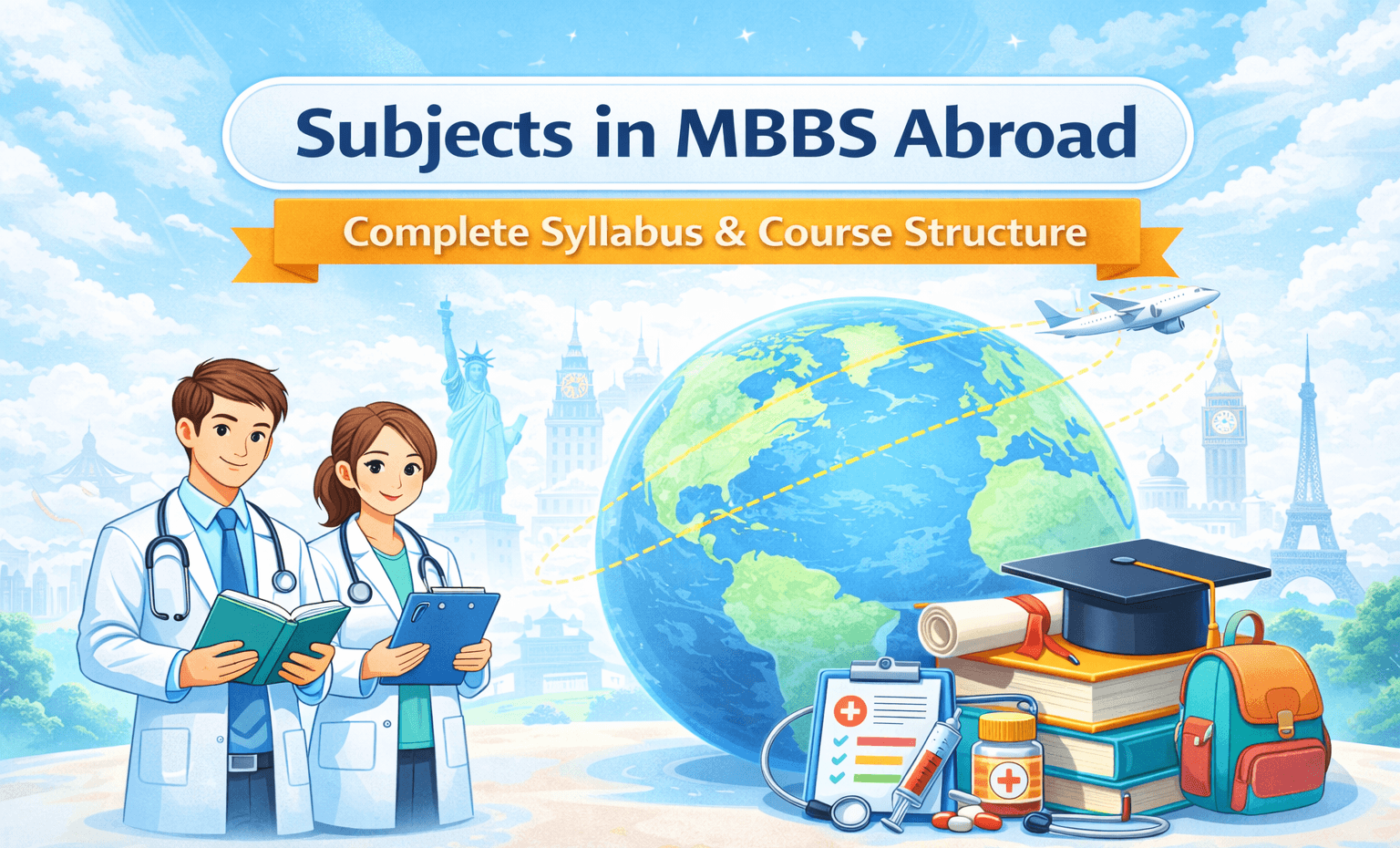
Subjects in MBBS Abroad: Complete Syllabus & Course Structure
Studying MBBS abroad has become one of the most popular choices for Indian medical aspirants who are unable to secure a government medical seat in India or cannot afford the enormous course fee of private medical colleges. Every year, thousands of students travel to countries like Russia, Kazakhstan, Kyrgyzstan, Georgia, and Uzbekistan to pursue their medical Dreams.
However, before choosing to study medicine abroad, the most important thing for a student to understand is the MBBS syllabus and the subjects included in that course.
The MBBS curriculum of foreign Universities is designed to provide a strong foundation in medical sciences, followed by clinical training and real-time experiences. In this article, we will learn the subjects in MBBS abroad year-wise, the overall syllabus structure, and what students can expect throughout the course.
This guide will help the students to understand how medical education abroad is structured and what knowledge and skills they will gain during the program.
Understanding the MBBS Abroad Curriculum
Most universities abroad follow a 5 to 6-year MBBS program, which includes both academic study and clinical training. The course is usually divided into three main stages.
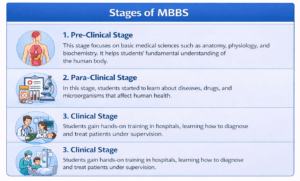
1. Pre-Clinical Stage
This stage focuses on basic medical sciences such as anatomy, physiology, and biochemistry. It helps students’ fundamental understanding of the human body.
2. Para-Clinical Stage
In this stage, students started to learn about diseases, drugs, and microorganisms that affect human health.
3. Clinical Stage
Students gain hands-on training in hospitals, learning how to diagnose and treat patients under supervision.
Most medical universities follow guidelines recommended by the National Medical Commission to ensure that graduates are eligible to practice medicine in India after passing the National Exit Test (NEXT).
MBBS Subjects Year-Wise
Understanding the year-wise subjects is one of the most important parts that will help students know exactly what they will study during their medical education abroad.
1. First Year MBBS Subjects (Foundation of Medicine)
The first year focuses on basic medical sciences, which are essential for understanding the human body.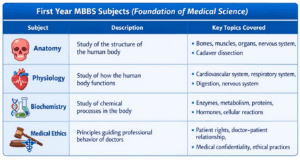
Anatomy
Anatomy is the study of the structure of the human body. Students learn about:
-
Bones and skeletal system
-
Muscles and tissues
-
Organs and organ systems
-
Nervous system structure
Students also perform cadaver dissection, which helps them understand the real structure of human organs.
Physiology
Physiology explains how different organs and systems of the body function.
Important topics include:
-
Blood circulation
-
Respiratory system
-
Nervous system
-
Digestive system
-
Hormonal regulation
Understanding physiology helps students identify normal body functions and recognize abnormalities.
Biochemistry
Biochemistry focuses on chemical processes inside the body.
Students learn about:
-
Enzymes
-
Proteins and carbohydrates
-
Metabolism
-
Hormones
-
Cellular reactions
This subject is important for understanding disease development at a molecular level.
Medical Ethics
Medical ethics introduces students to Professional behavior and Ethical responsibilities of doctors.
Topics include:
-
Patient rights
-
Doctor-patient relationship
-
Medical confidentiality
-
Ethical decision-making in healthcare
2. Second Year MBBS Subjects (Core Medical Sciences)
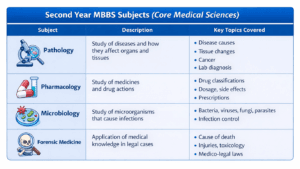
In the second year, students start studying diseases and medicines.
Pathology
Pathology is the study of diseases and how they affect the human body.
Students learn about:
-
Causes of diseases
-
Tissue changes during illness
-
Laboratory diagnosis
-
Cancer and other disorders
Pathology helps doctors understand how diseases develop and progress.
Pharmacology
Pharmacology focuses on drugs and medications used to treat diseases.
Topics include:
-
Drug classifications
-
Drug actions and side effects
-
Dosage calculations
-
Safe prescription practices
This subject is essential for effective patient treatment.
Microbiology
Microbiology studies microorganisms that cause infections.
Students learn about:
-
Bacteria
-
Viruses
-
Fungi
-
Parasites
They also study infection control and prevention methods.
Forensic Medicine
Forensic medicine applies medical knowledge to legal investigations.
Students learn about:
-
Cause of death
-
Injury analysis
-
Toxicology
-
Medical law and ethics
This subject is important for handling medico-legal cases.
3. Third Year MBBS Subjects (Beginning of Clinical Training)
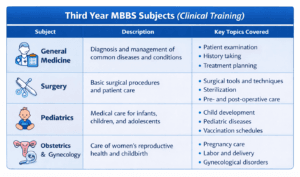
The third year marks the beginning of clinical exposure in hospitals.
Students start interacting with patients and applying theoretical knowledge.
General Medicine
General medicine focuses on diagnosing and managing common diseases.
Students learn:
-
Clinical examination methods
-
Patient history taking
-
Diagnosis techniques
-
Treatment planning
Surgery
Surgery introduces students to surgical procedures and operation techniques.
Topics include:
-
Surgical instruments
-
Sterilization techniques
-
Minor surgical procedures
-
Pre-operative and post-operative care
Pediatrics
Pediatrics focuses on healthcare for infants, children, and adolescents.
Students study:
-
Child development
-
Pediatric diseases
-
Vaccination programs
-
Nutrition for children
Obstetrics and Gynecology
This subject deals with pregnancy, childbirth, and women’s reproductive health.
Important topics include:
-
Prenatal care
-
Labor and delivery
-
Gynecological disorders
-
Family planning
4. Fourth Year MBBS Subjects (Advanced Clinical Specialties)
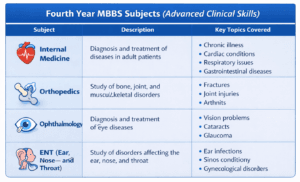
In the fourth year, students study specialized branches of medicine.
Internal Medicine
Internal medicine focuses on diagnosing and treating diseases in adults.
Students study conditions such as:
-
Diabetes
-
Heart diseases
-
Respiratory disorders
-
Gastrointestinal diseases
Orthopedics
Orthopedics deals with bones, joints, and muscles.
Students learn about:
-
Fractures
-
Joint injuries
-
Arthritis
-
Musculoskeletal disorders
Ophthalmology
Ophthalmology focuses on eye diseases and vision problems.
Topics include:
-
Cataract
-
Glaucoma
-
Retinal disorders
-
Vision correction
ENT (Ear, Nose, and Throat)
ENT studies diseases related to:
-
Ear infections
-
Sinus problems
-
Throat disorders
-
Hearing issues
Students learn both medical and surgical treatments.
5. Final Year MBBS Subjects (Preparing for Medical Practice)
The final year prepares students for independent medical practice and public health responsibilities.
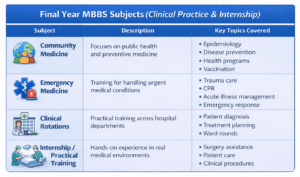
Community Medicine
Community medicine focuses on public health and disease prevention.
Students learn about:
-
Epidemiology
-
Vaccination programs
-
Health education
-
Rural healthcare systems
Emergency Medicine
Emergency medicine helps students to handle critical and life-threatening situations.
Examples include:
-
Trauma cases
-
Cardiac arrest
-
Severe infections
-
Accident management
Internship / Clinical Rotations
The final stage of MBBS abroad includes clinical internship training.
Students rotate through departments such as:
-
Medicine
-
Surgery
-
Pediatrics
-
Gynecology
-
Emergency care
This hands-on training helps students gain practical experience in treating patients.
How MBBS Subjects Abroad May Vary
Although the core medical subjects remain similar worldwide, some variations may exist depending on the country or university.
Factors that may differ include:
-
Teaching methods
-
Clinical exposure duration
-
Hospital training systems
-
Local healthcare practices
However, most universities follow international medical education standards recommended by organizations like the World Health Organization.
Why Understanding MBBS Subjects Is Important
Before choosing a medical university abroad, students should understand the MBBS syllabus and subjects because it helps them:
-
Prepare mentally for medical education
-
Understand the complexity of the course
-
Plan their study strategy
-
Choose the right specialization in the future
Medical education is rigorous, but a well-structured curriculum ensures students develop strong clinical knowledge and practical skills.
Conclusion
Studying MBBS abroad offers students a structured and comprehensive medical education. The curriculum gradually progresses from basic medical sciences to advanced clinical training, ensuring that students gain both theoretical knowledge and practical experience.
By understanding the subjects in MBBS abroad, students can prepare themselves better for the journey ahead and build a strong foundation for a successful career in medicine.
With dedication, proper training, and clinical exposure, students who complete their MBBS abroad can pursue opportunities in medical practice, postgraduate specialization, or research in the healthcare field.
Contact Us:
Phone: 7978940093
Address: Plot K3B/541, 1st Floor, Ghatikia Main Road, Near Saraswati Sishu Mandir, Ghatikia, Kalinganagar, Bhubaneswar, Odisha 751003.
Visit Our Website: www.acharyadrona.com
 Acharyadrona Edu World—Your Trust, Our Commitment.