Foreign Medical Graduate Licentiate Regulations 2021: Complete Guide for MBBS Abroad Students
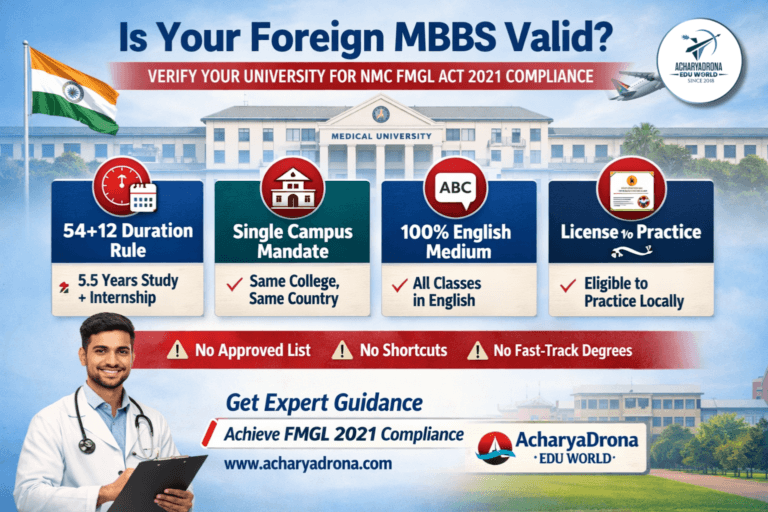
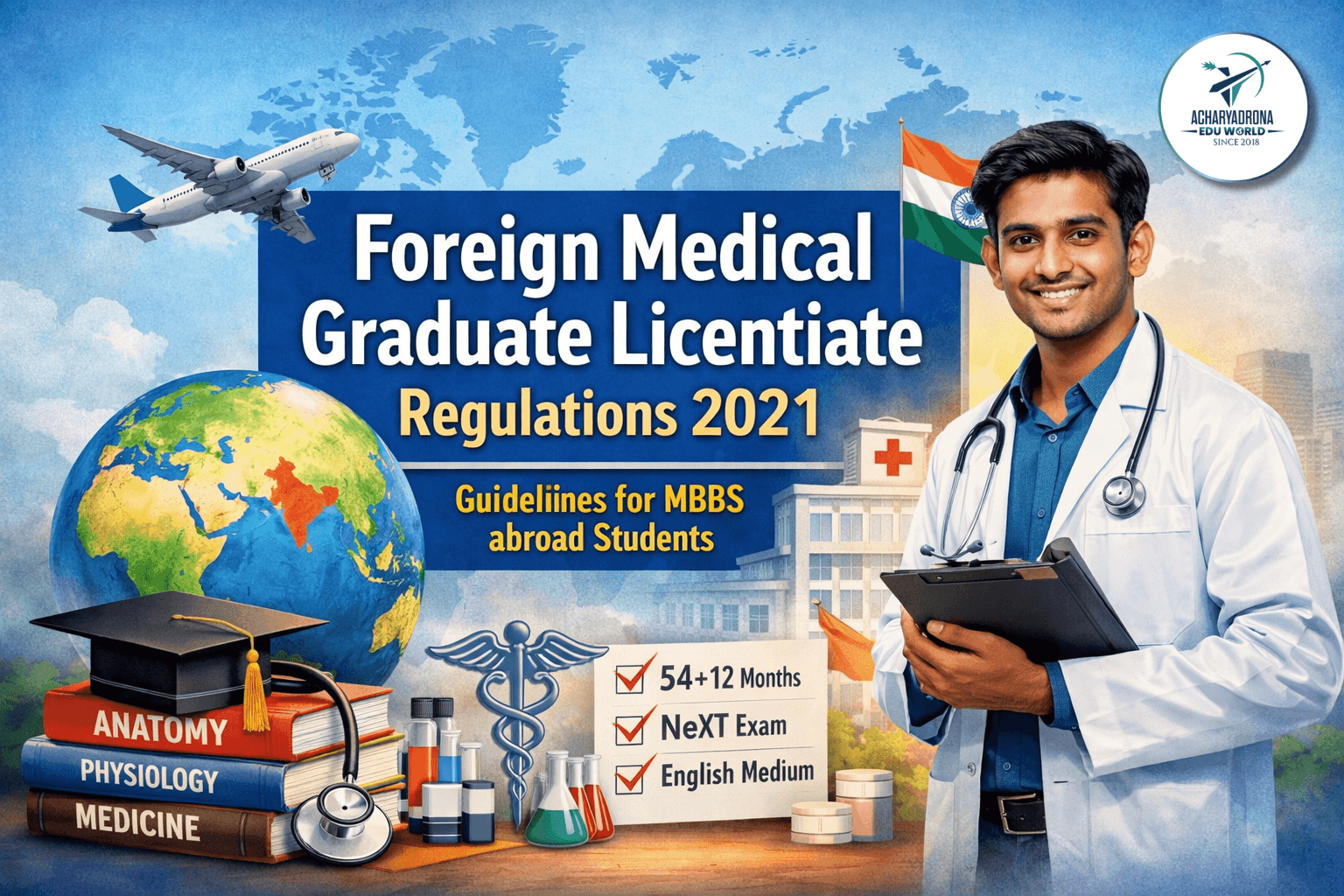
In the past few years, pursuing an MBBS degree from overseas has become a go-to option among Indian students. However, obtaining an MBBS degree from abroad is only beneficial if it’s recognized in India. To regulate this, the National Medical Commission introduced the Foreign Medical Graduate Licentiate Regulations 2021, which ordain clear standards for overseas medical education. One of the most critical concepts introduced under these regulations is that of a “commensurate” curriculum.
The term “commensurate” refers to the requirement that a foreign MBBS program must be equivalent in structure, content, and clinical training to the MBBS curriculum followed in India. This requirement is detailed in Schedule 1 of the regulations.
If a foreign university fails to meet even one of the prescribed standards, the degree may not be recognized, and the student may be deemed ineligible to practice medicine in India.
Complete Breakdown of NMC Schedule 1 Syllabus:
The NMC Schedule 1 syllabus is structured into three major phases of medical education.
Phase 1: Pre-Clinical (Foundation)
The first phase, known as the pre-clinical stage, forms the foundation of medical knowledge. It includes essential subjects
- Human Anatomy
- Physiology
- Biochemistry
These disciplines provide a comprehensive understanding of the structure and function of the human body, which is necessary for further medical training.
Phase 2: Para-Clinical (Bridge)
The second phase is the para-clinical stage, which serves as a bridge between basic sciences and clinical practice. This phase includes subjects such as
- Pathology
- Microbiology
- Pharmacology
- Forensic Medicine
These subjects help students understand disease mechanisms, diagnostic processes, and the principles of treatment, thereby preparing them for direct patient care.
Phase 3: Clinical (Core Practice)
The third and most important phase is the clinical stage. Under Schedule 1, this phase requires extensive practical training in various medical disciplines. Students must undergo
- General Medicine
- General Surgery
- Obstetrics & Gynaecology
- Paediatrics
- Community Medicine
- ENT
- Ophthalmology
This stage ensures that students gain real-world experience in diagnosing and treating patients.
In addition to theoretical knowledge, the regulations emphasize the importance of hands-on clinical training. Students are required to participate in hospital-based rotations across multiple departments, including
- Emergency services
- Orthopaedics
- Dermatology
- Psychiatry
- Laboratory services.
Such exposure is essential for developing practical skills and clinical judgment.
Another crucial requirement under Schedule 1 is the completion of a compulsory internship.
- Internship must be 12 months
- Must be in the same university
- Must include clinical logbook records
This is mandatory to appear for the National Exit Test.
Despite these clearly defined requirements, many foreign universities follow their own national curricula, which may not fully align with NMC standards. As a result, students often face challenges during apply for the NEXT Exam, to obtain a license to practice in India. At AcharyaDrona Edu World, we understand how complex and critical this verification process can be. That is why we conduct a comprehensive syllabus audit and compliance check for every university we recommend. Our goal is to ensure that students from Odisha and across India choose only those institutions that fully meet FMGL 2021 requirements and align with NMC Schedule 1 standards.
📞 Contact Us – AcharyaDrona Edu World
Don’t take risks with your medical career. Get expert guidance before you finalize your admission.
📱 Call / WhatsApp
+91 7978940093
info@acharyadrona.com
🌐 Website
📍 Location
Plot K3B/541, 1st Floor
Ghatikia Main Road
Near Saraswati Sishu Mandir
Kalinganagar, Bhubaneswar, Odisha – 751003