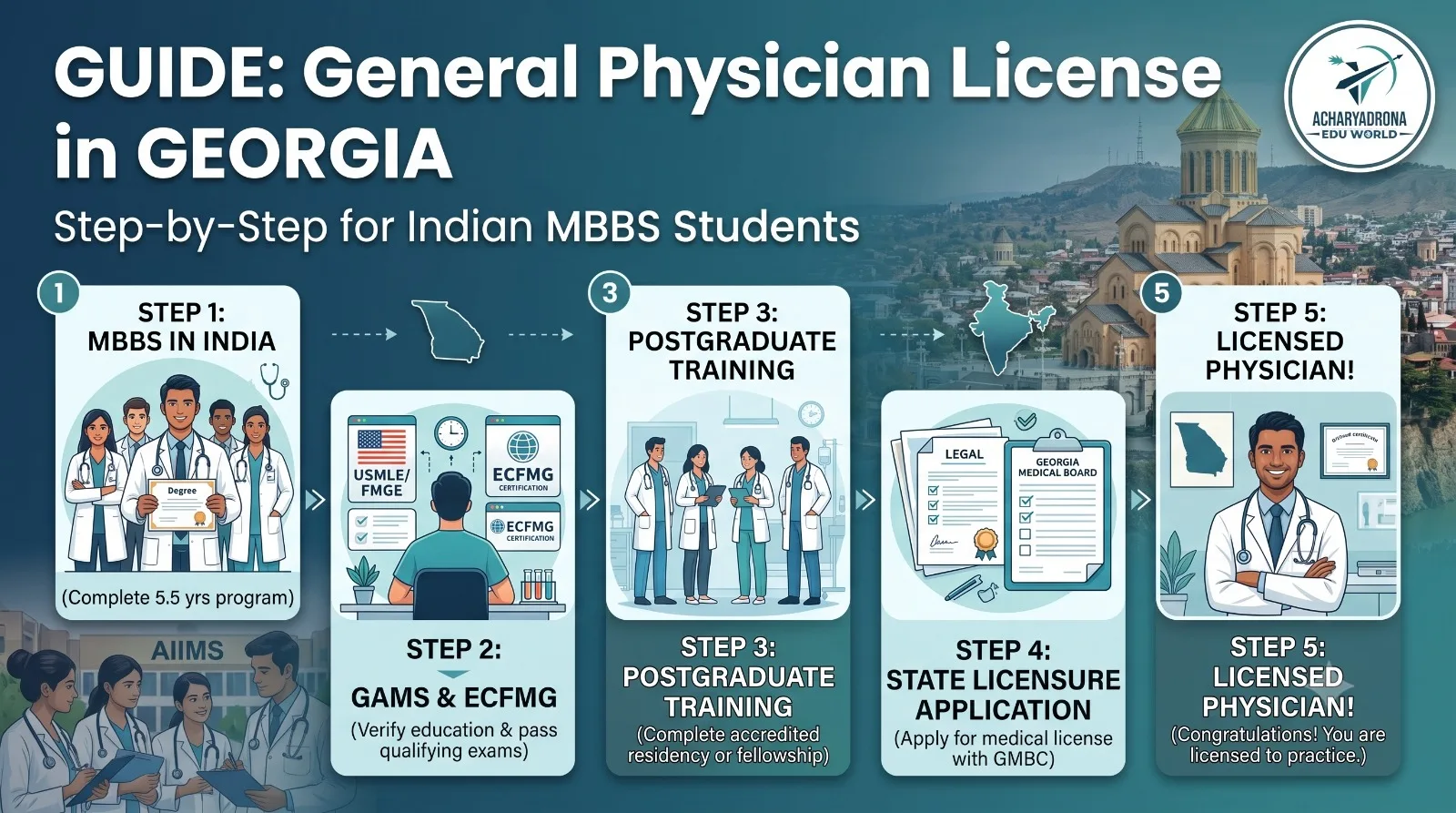
General Physician License in Georgia: Step-by-Step Guide for Indian MBBS Students
Are you an Indian medical graduate dreaming of building a career in the beautiful country of Georgia? You aren’t alone. With its world-class medical education and affordable living, Georgia has become a beacon for aspiring doctors globally. However, moving from an MBBS degree to an independent medical practice is a journey that requires more than just clinical knowledge—it requires a clear understanding of the local landscape.
Obtaining a Georgia medical practice license is a structured, merit-based process. Whether you are currently studying in a Georgian university or planning your path, it is vital to understand that the “license” you seek is a state certificate of independent practice. It’s not automatic upon graduation, but it is entirely achievable for those who are prepared to navigate the national exams and residency requirements. In this guide, we’ll demystify the legal framework, language requirements, and the step-by-step path to becoming a certified doctor in Georgia.
1. Licensing Authority & Legal Framework
In Georgia (country), the Ministry of Internally Displaced Persons from the Occupied Territories, Labour, Health and Social Affairs (often called Ministry of Health) regulates medical licensing. The Medical and Pharmaceutical Regulation Agency under the Ministry administers exams, while the Professional Development Council (at the Ministry) issues practice licenses. Key laws include the Law of Georgia on Health Care (2010) and the Law on Medical Practice (2005). These laws provide that only holders of a state medical certificate can practice independently.
2. Definition of GP License
Georgia does not use “license” per se but issues a state certificate for independent medical practice in a specialty. A physician earns this state certificate after postgraduate training (residency) and a national exam. This certificate confirms the doctor has met Georgian standards and can practice independently in their field.
3. Eligibility for Foreign Graduates
Foreign and Georgian citizens alike must have their medical diplomas recognized by Georgia’s Ministry of Education to qualify. Georgia maintains an official list of countries whose medical diplomas are automatically recognized. An Indian MBBS (Georgia’s MBBS is 6 years, similar) must come from an NCEQE-accredited university; India’s MBBS is not on Georgia’s automatic list, so an Indian degree requires nostrification. After recognition, foreign graduates must follow the same path as Georgians: pass required exams and residency. Importantly, Georgia’s laws explicitly grant right to practice regardless of nationality once requirements are met.
4. Degree & Internship Requirements
Georgia’s MD program is typically 6 years (5 academic + 1 clinical internship). The 1-year internship provides clinical exposure before the final exam. After graduation, a graduate must pass the National Post-Diploma Qualification Exam (NPDQE) to proceed to specialization. A residency (post-graduate vocational training) of varying length (commonly 2–6 years depending on specialty) follows; however, one can obtain a GP certificate after just 1 year of internship and exam, as Georgia distinguishes general practice residency separately. For licensure as a GP, at minimum the one-year internship plus exams are needed.
5. Licensing Exam (Unified State Exam)
Georgia’s licensing process involves two exams. First, the NPDQE (National Post-Diploma Qualification Exam) is taken upon MD graduation; it is administered by the Medical and Pharmaceutical Regulation Agency. After completing residency, the graduate must pass the Unified State Certification Exam (also called the “State Certification Exam”) to earn the license. The USCE covers general medical knowledge (MCQs and practical tasks). Upon passing, one receives the state certificate of independent practice. There is no separate “medical council exam” beyond these national exams.
6. Language Requirements & Exemptions
Proficiency in Georgian language is mandatory for independent medical practice. The law explicitly requires knowledge of the official language (Article 10) for licensure. Thus, foreign graduates must be fluent in Georgian to pass exams and practice. No formal translator provision is noted for licensing (except temporary practice rules). English is not an exam option.
7. Application Procedure (Steps, Documents, Fees, Timeline)
After residency and passing exams, the applicant submits for a practice certificate. The Professional Development Council reviews applications. Required documents typically include:
- Diploma from NCEQE-accredited medical school
- Proof of passed NPDQE and residency completion
- Passport/ID and work permit (if foreign)
- Georgian language proficiency certificate (if available)
- Application form and fee.
Exact fee is modest (a few hundred GEL). The process involves the Council’s decision. For recognized diplomas (per Article 8) no state exam is needed; otherwise, passing the state exam suffices. Timeline: after exam results and Council approval, the certificate is issued (a matter of weeks to months, varying by case).
8. Rights After Licensing (Scope of Practice)
Holders of the Georgian state certificate may practice medicine independently in Georgia in their certified specialty. They can work in hospitals or open clinics. The certificate is equivalent to a medical license. It allows full medical duties (diagnosis, treatment, prescribing). A licensed GP can later sub-specialize (residency in another field). Georgian law affords equal practice rights without national quotas once certified.
9. Renewal / CPD Requirements
Georgia requires continuing medical education (CME) but has no fixed short-term renewals; the state certificate is valid indefinitely after attainment. Doctors must maintain professional standards, and ongoing training is expected by law (e.g., via congresses, courses). There is no re-examination after certification, but sub-specialty training or recertification may require further exams.
10. Interaction with India’s NMC / FMGL / NExT
India’s NMC accepts degrees from Georgia’s accredited universities (e.g., Ivane Javakhishvili Tbilisi State U) for FMGE/NExT purposes. However, a Georgian practice certificate does not replace the FMGE for licensure in India. An Indian graduate with a Georgian license still must clear NEXT/FMGE to practice in India. Conversely, NMC/FMGL does not incorporate foreign licenses into Indian registration beyond degree recognition.
11. Typical Costs & Timeline
After MBBS (6 years), timeline to license is typically 7–9 years (1-year internship, up to ~3 years residency, exams). Costs: tuition/residency fees (varies, often covered by stipend), exam fees (~50–100 GEL per exam), and administrative fees (~200–300 GEL for council). Language training may cost extra. Living expenses in Georgia are moderate. Overall, expect ~₹2–4 lakhs per year of residency/intern training costs.
12. Myths & Clarifications
- Myth: MBBS alone grants license. Clarification: Must pass NPDQE + state exam after training.
- Myth: English is accepted for exam. Clarification: Only Georgian (official language) is allowed.
- Myth: Once passed NPDQE, license is automatic. Clarification: NPDQE allows residency; independent practice requires a subsequent state exam.
- Myth: All foreign diplomas are equal. Clarification: Only diplomas recognized by the Ministry’s list qualify; others need explicit recognition or exam.
13. Latest Updates (2024–2026)
- Georgia continues with its two-exam system; no major changes have been announced recently.
- The Medical Council has published official guidelines and exam syllabi on the Ministry site.
- India’s embassies have clarified process for 2024–25: foreign students (including Indians) must complete NPDQE and residency to georgia.
- The Law of Georgia on Health Care (latest consolidated edits to 2010 law) still governs recognition of foreign diplomas.
Junior Doctor License in Georgia: What Indian Students Should Know
After completing the MD (equivalent to MBBS) program in Georgia, graduates receive a Junior Doctor License or internship registration, depending on the university and the
country’s medical regulations. This license allows graduates to begin supervised clinical practice or internship within Georgia as part of their journey toward becoming fully licensed
doctors.
WHAT IS A “JUNIOR DOCTOR” IN GEORGIA?
After finishing the 6-year MD degree, you automatically become a “Junior Doctor“.
❌ You DO NOT get an independent license.
✅ You can work in a hospital ONLY under the strict supervision of a senior doctor.
❌ You CANNOT make independent medical decisions, write prescriptions, or sign official papers.
HOW TO GET A FULL LICENSE & DURATION
To get a full independent license to practice, a student must:
1️⃣ Pass the National State Exam (NPDQE).
2️⃣ Complete a mandatory hospital Residency.
The Actual Duration:
* 6 Years = University MD Degree.
* 2 to 3 Years = Residency for General Fields.
* 4 to 6 Years = Residency for Specialist Fields (like Surgery).
* Total Time: *8 to 12 Years* to become a fully independent licensed doctor in Georgia.
THE NMC ROADBLOCK (FMGL 2021 ACT)
If the NMC accepted the Junior Doctor license as equal to a General Physician license, it would be easy. But as per the *FMGL 2021 Act, it is NOT possible.* The NMC states your foreign license must be at par with a local citizen’s license. Since a local citizen cannot practice independently as a Junior Doctor, the NMC does not accept it. You are legally forced to do the residency in Georgia.
THE DEADLY “10-YEAR COMPLETION RULE”
Because you have to do a residency, you run directly into the NMC’s hardest rule: *You must complete EVERYTHING within 10 years from the date of joining college abroad.*
Within those *10 Years*, you must finish:
1️⃣ 6 Years MD Course in Georgia.
2️⃣ 2 to 6 Years local Residency & licensing.
3️⃣ Clear FMGE / NExT Exam in India.
4️⃣ Complete 1-Year Internship (CRMI) in India.
The Mathematical Trap:
* Best Case (General Medicine): 6 yrs (MD) + 2 yrs (Residency) + 0.5 yr (NExT) + 1 yr (Internship) = *9.5 Years!* (Only a 6-month margin for error).
* Specialist Case (Surgery): 6 yrs + 4 to 6 yrs residency = *10+ Years* (You automatically fail the NMC rule before even returning to India).
If you get even 1 backlog, fail a semester, or face visa delays, you will cross the 10-year limit and your degree becomes INVALID in India forever.
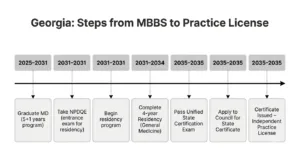
Timeline: Georgia Licensing Process
FAQ:
1. What exams must I pass to practice in Georgia?
After your MBBS, you must first pass the National Post-Diploma Qualification Exam (NPDQE) to enter residency. Once you complete your residency, you must pass the Unified State Certification Exam (USCE) to earn your license for independent practice.
2. Is there any way to skip these exams?
No. Georgia only allows automatic licensure for countries with established reciprocal agreements. Since India is not on that list, all Indian graduates must follow the standard exam and residency path.
3. What does the internship and residency process look like?
Georgia’s medical program includes a 1-year internship (usually within the 6-year degree). Following this, you must complete a residency, which typically ranges from 1 to 3+ years depending on your chosen specialty.
4. Is the Georgian language mandatory?
Yes, fluency in Georgian is a legal requirement for independent medical practice. Both the NPDQE and the state certification exams are conducted exclusively in Georgian.
5. Which authority is responsible for my medical license?
The Professional Development Council, operating under the Ministry of Internally Displaced Persons from the Occupied Territories, Labour, Health and Social Affairs (Ministry of Health), issues the practice certificate.
6. What essential documents are required for my application?
You will need your NCEQE-accredited MBBS diploma, academic transcripts, proof of passed NPDQE, residency completion certificates, a valid passport/work permit,
7. What is the total estimated timeline to become a licensed doctor?
The path generally takes 7–9 years: 6 years for your medical degree (including internship) plus 1–3 years for residency and the exam/licensing process.
8. Does my Georgian license exempt me from the FMGE/NExT exam in India?
No. A Georgian practice license does not replace the mandatory FMGE or NExT exam required by the National Medical Commission (NMC) to practice medicine in India.
9. Can I work as a doctor before obtaining my full license?
You can work as a junior doctor or in supervised clinical roles after your MBBS, but you cannot practice medicine independently until you hold the official state certificate.
10. Is there a temporary pathway for foreign doctors?
Yes, the Ministry of Health can issue a temporary practice permit for up to one month, though this is intended for specific circumstances and is not a substitute for full licensure.
11. Does my license expire or require renewal?
The Georgian state certificate is valid indefinitely. However, you are expected to participate in ongoing Continuing Medical Education (CME) to maintain your professional standards.
12. Are there practical skill assessments in the licensing exams?
Yes. The Unified State Certification Exam includes both theoretical testing (MCQs) and practical tasks to ensure you are clinically ready for independent practice.
13. Can I open my own private clinic once I am licensed?
Absolutely. Once you hold a state certificate for independent practice, you have the legal right to work in any hospital or establish your own private clinic in your certified specialty.
Contact Us:
 Call: 9114439351/6371680309 |
  Bhubaneswar, Odisha
Visit Our Website: www.acharyadrona.com
Visit Us: Plot K3B/541, 1st Floor, Ghatikia Main Road, Near Saraswati Sishu Mandir, Kalinganagar, Bhubaneswar, Odisha 751003