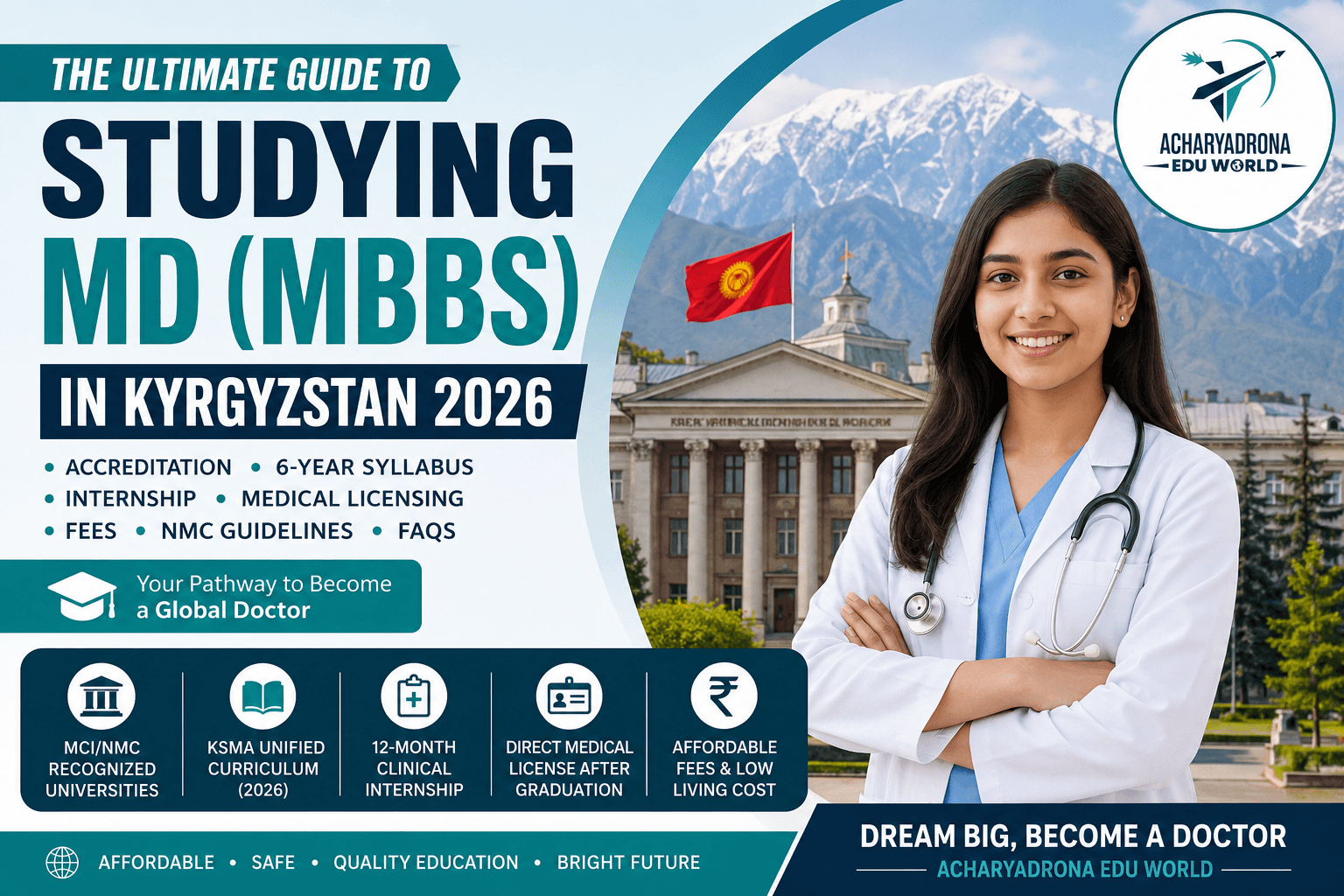
The Ultimate Guide to Studying MD (MBBS) in Kyrgyzstan 2026: Accreditation, 6-Year Syllabus & Medical Licensing Process
Generally, in India, MD means Doctor of Medicine. In countries like India and the UK, it is a 3-year postgraduate degree pursued after completing an MBBS. But in the case of Kyrgyzstan, it is totally different; MD in education also means Doctor of Medicine but is an undergraduate primary medical qualification, equivalent to an MBBS degree in India. Its duration is 6 years, like MBBS.
As we know, Kyrgyzstan is a prominent medical education destination for many Indian students, so aspirants should get a clear view regarding terms like MBBS and MD.
Why Choose Kyrgyzstan for MBBS in 2026?
Kyrgyzstan has emerged as one of the most preferred destinations for Indian students seeking an affordable and internationally recognized medical education. With modern universities, experienced faculty, English-medium instruction, and growing government oversight to improve educational standards, the country continues to attract thousands of aspiring doctors every year.
The medical education reforms introduced in 2026 have further strengthened the quality of MBBS programs by emphasizing standardized curricula, enhanced clinical training, and stricter accreditation processes. Combined with affordable tuition fees and lower living costs, Kyrgyzstan offers an excellent balance between quality education and value for money.
MBBS in India vs MD in Kyrgyzstan
In India:
Students receive an MBBS (Bachelor of Medicine & Bachelor of Surgery) degree. Its duration is 4.5 years + 1 year internship
In Kyrgyzstan
Students receive an MD (Doctor of Medicine) degree.
Although the names are different, the MD course in Kyrgyz universities is an undergraduate medical qualification equivalent to MBBS and is recognized internationally by WHO.
The medical course follows the 5+1 structure. For the first five years, students study Basic Medical Sciences, Clinical Sciences, Laboratory Training, and Hospital Rotations. A dedicated 12-month compulsory clinical internship is conducted in the study hospitals.
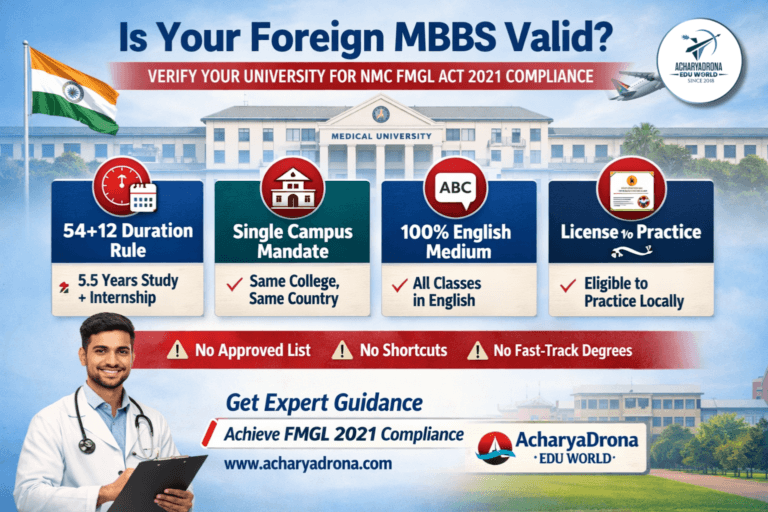
This structure satisfies the academic pattern required under the Foreign Medical Graduate Licentiate Regulations (FMGL) 2021.
Course Duration: The 5+1 Model
Most medical universities in Kyrgyzstan follow a structured 6-year curriculum consisting of 5years Academic studies and 1 yer intership.
| Duration | Study Pattern |
| Years 1–5 | Academic studies + Clinical rotations |
| Year 6(last year) | Full-time Rotational Internship |
The 1-year clinical internship satisfies the NMC 12-month internship rule:
Kyrgyzstan’s Medical Education Reform (2026)
In 2026, the government introduced a centralized medical education framework aimed at improving the educational quality of the country.
This reform aimed to :
- Eliminate substandard medical institutions.
- Introduce a unified curriculum framework.
- Improve clinical training standards.
- Ensure better infrastructure across universities.
- Increase international credibility of Kyrgyz medical education.
KSMA Unified Curriculum Framework:
As of June 1, 2026, a new state framework mandates that every single university delivering an international MD (MBBS) programme must legally follow and report directly to the I.K. Akhunbaev Kyrgyz State Medical Academy (KSMA) in Bishkek.
Highlights of the Law:
Unified Curriculum
There are no longer separate, customized syllabi across different colleges. To maintain their licenses, all medical faculties are legally required to enter into an educational franchise agreement under KSMA, adopting the strict KSMA Unified Course Standards.
Even Government Universities Comply
This rule does not just apply to private medical entities. Major public institutions—such as the highly prestigious Kyrgyz National University (KNU), which is a premier government university—must strictly follow and report under the standard KSMA syllabus framework.
Strict Quality Reporting
Universities that failed to meet these strict infrastructure and curriculum standards by the state deadline have officially had their medical licenses suspended or revoked by the Ministry of Health, with students being redistributed to fully compliant, accredited campuses.
This means whether a student secures a seat directly at KSMA, at another public giant like Kyrgyz National University (KNU), or a top-tier accredited private academy, they are guaranteed to study the same, high-standard syllabus that is internationally benchmarked and fully verified.
Official 2026 Accreditation Update
In early 2026, the government started an Accreditation review and catagorised the Medical university based on compliance with infrastructure, faculty, hospital affiliations, and educational standards. There is something Aspirants who want to study MBBS in kyrgyz should know about accreditation before choosing a university.
Ministry of Health Accreditation List (With Locations)
The Ministry of Health of Kyrgyzstan officially released the results of its rigorous state accreditation review.
-
Exempted from Review (Highest Standalone Status)
Per statutory legislation, these premium apex institutions are automatically verified, were not subject to the basic review process, and are located in the capital city of Bishkek:
- Kyrgyz State Medical Academy (KSMA) — Location: Bishkek
- Kyrgyz Russian Slavic University (KRSU) — Location: Bishkek
-
Universities Granted Full 6-Year Accreditation
These institutions successfully satisfied all global parameters regarding clinical facilities, materials, and training standards:
- International Higher School of Medicine (IHSM) — Main Location: Bishkek (Other campuses: Cholpon-Ata & Osh)
- Osh State University (Medical Faculty) — Location: Osh City (The second-largest government university)
- International University of Kyrgyzstan (IUK) — Location: Bishkek
- Asian International University named after S. Tentishev — Location: Kant City (Near Bishkek)
-
Universities Granted Non-Conditional 1-Year Accreditation
These colleges must report updates and satisfy ongoing criteria annually:
- Jusup Balasagyn Kyrgyz National University (KNU) — Location: Bishkek (Premier Government University)
- Jalal-Abad State University (JASU) — Location: Jalal-Abad City (Renowned Government College)
- Kyrgyz-Uzbek International University — Location: Osh City
- Issyk-Kul State University — Location: Karakol City
- Jalal-Abad International University — Location: Jalal-Abad City
- University of South Asia — Location: Roaf/Bishkek Area
- International European University — Location: Bishkek
⚠️ Warning: A total of 13 medical universities completely failed the accreditation review due to substandard clinical resources, meaning their licenses are suspended and they are unauthorized to register fresh international batches.
Should Students Avoid 1-Year Conditionally Accredited Universities?
The Answer is No. The term “One-Year Conditional Accreditation “ May create concern among the parents, but Conditional accreditation does not mean the university provides poor-quality education or does not meet NMC regulations. In many cases, it only reflects ongoing management or quality-review processes rather than academic education quality.
Government universities with established academic systems, experienced faculty, and affiliated teaching hospitals may receive conditional accreditation while progressing toward longer accreditation periods.
However, students should focus on:
- Confirm the university’s current recognition and its accreditation category.
- Ensure it is listed in the World Directory of Medical Schools (WDOMS).
Verify compliance with the latest NMC regulations before taking admission
NMC Compliance for Indian Students:
But before taking admission, Indian students must verify that the institution has authentic government recognition, official state accreditation, and fully complies with the National Medical Commission (NMC) regulations.
Key considerations include:
- English-medium instruction
- Adequate course duration
- Structured clinical training
- Internship integrated into the medical program
- Recognition by the relevant authorities
- Eligibility for medical registration in the country where the degree is awarded
Full Year-Wise Academic Syllabus (KSMA Framework)
Here is the exact layout of the core medical subjects you will study semester-by-semester across the first five years under this unified state standard.
Year 1: Pre-Clinical Foundations
- Normal & Topographical Anatomy (Osteology, Myology, Splanchnology)
- Histology, Cytology, and Embryology
- Medical Biology & General Genetics
- General, Inorganic & Bioorganic Chemistry
- Medical & Biological Biophysics
- Latin Language & Medical Terminology
- Russian / Kyrgyz Language (Targeted modules for basic patient history taking)
- History of Medicine, Philosophy, & Manas Studies
Year 2: Para-Clinical & Basic Pathologies
- Normal Human Physiology
- General & Clinical Biochemistry
- Microbiology, Virology, and Immunology
- Pathological Anatomy (General Pathology)
- Pathological Physiology (Pathophysiology Principles)
- General Hygiene & Public Health Metrics
- Fundamentals of Patient Care (Basic nursing procedures and manipulation mechanics)
- Emergency Medical Assistance / First Aid Algorithms
- General and Medical Psychology
Year 3: Introduction to Clinical Specialties & Bedside Diagnostics
- Basic & Clinical Pharmacology
- Study of Internal Medicine (Physical clinical examination methods and case history taking)
- Basics of Surgical Diseases (Introduction to General Surgery and operating room safety)
- Education of Child Diseases (Introductory Pediatrics)
- General Surgery & Operative Anatomy / Topographical Surgery
- Medical Radiology & Clinical Imaging Diagnostics (X-Ray, Ultrasound, CT, MRI reading)
- Dermatovenereology (Skin & Venereal Diseases)
- Urology & Medical Ecology
Year 4: Systemic Modules & Hospital Faculty Rotations
- Faculty Therapy (Systemic Internal Medicine: Cardiology, Pulmonology, Gastroenterology)
- Faculty Surgery (Abdominal, Thoracic, and Endoscopic Procedures)
- Obstetrics and Gynecology
- Pediatrics (Systemic Childhood Pathologies)
- Infectious Diseases & Tropical Medicine
- Nervous Diseases (Neurology) & Medical Genetics
- Phthisiology (Tuberculosis Tracking, Staging, and WHO Protocol Controls)
- Ophthalmology (Eye Diseases) & Otorhinolaryngology (ENT)
- Epidemiology, Public Health Economics, & Hospital Management
Year 5: Hospital Practice, Emergencies, & Medical Law
- Hospital Therapy (Complex Multi-Organ Conditions, Differential Diagnosis, and Comorbidities)
- Surgery (Advanced Surgical Interventions, Trauma Surgeries, and Operative Protocols)
- Pediatrics & Neonatology
- Oncology & Radiation Therapy
- Traumatology, Orthopedics, & Disaster Medicine
- Psychiatry, Narcology, and Clinical Psychology
- Anesthesiology, Critical Care, and Resuscitation Medicine (ICU Training)
- Forensic Medicine & Statutory Medical Jurisprudence (Medical Law)
- Military Medical Training & Extreme Medicine (Toxicology)
Year 6: The Mandatory 12-Month Rotational Internship Syllabus
During the final 52 weeks, Students need to work as apprentice doctors in municipal hospitals and state teaching clinics in Bishkek.
The internship syllabus rotates across four primary pillars:
- Internal Medicine & Outpatient Services: Managing independent admissions, processing case sheets, and leading morning rounds across Cardiology, Gastroenterology, Pulmonology, and Nephrology wards.
- General Surgery & Trauma Postings: Pre-operative patient stabilization, post-operative recovery monitoring, wound management, Operating Theater (OT) scrubbing assistance, and primary fracture cast/plaster room tracking.
- Maternal & Child Health: Tracking maternal-fetal health parameters in labor wards, assisting in normal vaginal deliveries, calculating neonatal APGAR scores, and managing pediatric infectious outbreaks.
- ICU, Resuscitation & Emergency Care: Executing Cardiopulmonary Resuscitation (CPR), Basic Life Support (BLS), and Advanced Cardiac Life Support (ACLS) algorithms. Managing fluid balance in shock states, preparing for emergency intubation, and casualty triage.
Rules for Getting a Medical License in Kyrgyzstan
To comply with global regulatory rules—which require international students to be legally eligible to practice medicine in their host country—the Ministry of Health of Kyrgyzstan operates on an integrated registration model.
Direct Legal Parity
Kyrgyzstan’s laws state that the MD diploma awarded by state academies holds complete legal parity between local citizens and international candidates. There is no separate Foreign Medical Licensing Exam that graduates must take after completing their degree; the MD qualification itself carries the legal right to practice medicine in Kyrgyzstan.
The State Final Attestation
To activate this legal right, students must successfully clear the mandatory State Final Attestation (Davlat Yakuniy Attestatsiyasi – DYA) at the end of the sixth year.
The State Final Attestation consists of two major components:
- OSCE (Objective Structured Clinical Examination)
Station-based practical examinations that assess emergency medicine skills, clinical procedures, and competency using medical simulators. - Comprehensive Theoretical Panel
An oral defense of multidisciplinary clinical patient case files conducted before an independent state examiner board.
GP vs. Specialist
General Practitioner (GP)
After successfully clearing the DYA, graduates can apply directly to the Ministry of Health for registration and begin practicing as a General Practitioner in local polyclinics and primary healthcare facilities.
Specialist Doctor
Graduates who wish to specialize in fields such as Surgery, Cardiology, Pediatrics, Orthopedics, or other medical specialties must qualify through the national competitive entrance process for Ordinatura (Clinical Residency). This postgraduate training generally requires an additional 2 to 3 years of supervised hospital-based education before specialist registration.
Conclusion:
With the latest developments in Kyrgyzstan’s medical education system, including updated accreditation standards, a structured curriculum, mandatory clinical internship, and a defined medical licensing pathway, students have a clearer understanding of what to expect before beginning their journey.
However, selecting the right university and navigating admissions can still be challenging. Every student’s NEET score, budget, career goals, and eligibility are different, making personalized guidance essential. At Acharyadrona Edu World, we are committed to helping students and parents make informed decisions with complete transparency. Since 2018, we have guided 800+ students and parents in pursuing MBBS admissions in India and abroad.
Frequently Asked Questions (FAQs)
- Is the medical degree from Kyrgyzstan recognized in India?
Answer: Yes. The degree awarded is an MD (Physician), which is globally recognized and considered fully equivalent to an MBBS degree in India. As long as you graduate from a university recognized by the Ministry of Health of Kyrgyzstan and listed in the World Directory of Medical Schools (WDOMS), it is valid.
- What is the total duration of the MBBS/MD course in Kyrgyzstan?
Answer: The total duration is 6 years (5 years of academic study + 1 year of mandatory clinical internship).
- Does the Kyrgyzstan internship comply with the NMC FMGL Act 2021 Schedule 1?
Answer: Yes. The final 6th year is a 12-month continuous, hands-on clinical clerkship conducted at the same foreign medical institution where you completed your studies. It features no classroom lectures, mirroring the practical requirements of India’s Compulsory Rotating Medical Internship (CRMI).
- What is the 2026 KSMA State Monopoly Law?
Answer: As of June 1, 2026, Kyrgyzstan passed a centralized educational reform making the I.K. Akhunbaev Kyrgyz State Medical Academy (KSMA) the sole standard-setter. Every university offering an international medical program must legally follow and report under the strict, unified KSMA curriculum framework to eliminate substandard education.
- Why do some top government universities like Kyrgyz National University (KNU) only have a 1-year accreditation?
Answer: Under Kyrgyz law, a university must complete a full 5-to-6 year operational cycle with its international program or graduate its first batch before receiving a permanent 6-year stamp. Since Kyrgyz National University (KNU) introduced its international English-medium MD course exactly five years ago, it was granted a standard 1-year conditional monitor status. It remains fully accredited, completely safe to join in 2026, and is on track for a permanent 6-year renewal in 2027. It is a premier government body, so it is 100% secure.
- Can I practice medicine in Kyrgyzstan after graduation?
Answer: Yes. Kyrgyzstan operates on an integrated registration model where your state MD diploma holds direct legal parity with local citizens. There is no separate Foreign Licensing Exam after graduation; the degree natively carries the legal right to practice. Once you pass the university’s final State Final Attestation (DYA) exam (consisting of practical OSCEs and oral defenses), you can register as a General Practitioner (GP).
- Is the medium of instruction completely in English?
Answer: Yes. For international student wings, the medium of instruction, textbooks, clinical assignments, and board examinations are strictly 100% in English.
- Will I face an NMC violation because of local language barriers?
Answer: No. In premium international faculties and top-tier colleges, the classrooms consist almost entirely of Indian medical aspirants. Because the entire student body in these dedicated wings shares the same English requirement, the medium of instruction, clinical case sheet writing, and examinations remain 100% strictly in English.
- Why do I still need to learn Russian or Kyrgyz if the course is in English?
Answer: While your books and exams are in English, you will interact with local citizens during your hospital rotations in the clinical years. Basic conversational language classes are built into the first and second-year syllabus exclusively to help you take patient histories and communicate comfortably during ward rounds.
- What happens if a university completely failed the 2026 Ministry of Health accreditation review?
Answer: A total of 13 medical colleges failed the strict 2026 infrastructure and clinical resource audit. Their licenses have been suspended, and they are legally unauthorized to accept fresh international students. You must strictly avoid unlisted or banned colleges.
- What is the cost of studying MBBS/MD in Kyrgyzstan?
Answer: Kyrgyzstan is highly popular because it is incredibly cost-effective. On average, the tuition fee ranges between USD 3,500 to USD 6,000 per year, depending on whether you choose an apex state academy or a conditional government/private university.
- Do I need to clear NEET to study in Kyrgyzstan?
Answer: Yes. To comply with Indian regulatory guidelines and ensure you are eligible to sit for the screening exams (FMGE/NExT) when you return to India, clearing the NEET-UG exam with qualifying marks in your admission year is mandatory.
- What is the “DYA” or State Final Attestation?
Answer: The Davlat Yakuniy Attestatsiyasi (DYA) is the final state-supervised board examination taken at the end of the sixth year. It features a station-based OSCE (Objective Structured Clinical Examination) on high-fidelity dummy simulators and an oral defense of multidisciplinary case files before a state panel. Passing it is required to receive your degree and your GP license.
- What is the difference between a General Practitioner and a Specialist license in Kyrgyzstan?
Answer: Clearing your six-year degree grants you a General Practitioner (GP) license to work in primary healthcare polyclinics. If you wish to practice a specialty like Cardiology, Neurosurgery, or Pediatrics, you must clear competitive entry exams and complete an additional 2 to 3 years of Ordinatura (Clinical Residency).
- Once I finish my 6th-year internship in Kyrgyzstan, can I practice immediately in India?
Answer: No. While your Kyrgyzstan internship satisfies global criteria and allows you to sit for the Indian screening exam, all Foreign Medical Graduates must pass the screening test (FMGE/NExT) and subsequently complete a 12-month Compulsory Rotating Medical Internship (CRMI) inside an approved Indian hospital to gain permanent registration.
- What is the weather like in Kyrgyzstan, and how do Indian students adapt?
Answer: Kyrgyzstan has a continental climate, meaning it experiences distinct, beautiful seasons. Summers are warm and pleasant (around 25°C to 35°C), while winters can get quite cold, with temperatures dropping between 0°C and -10°C (and sometimes lower), accompanied by beautiful snowfall. All hostels, universities, and public buildings are equipped with centralized, highly efficient 24/7 heating systems. Indian students adapt easily by purchasing standard winter jackets, thermal innerwear, and snow boots locally in Bishkek or Osh at affordable prices.
- Is Indian food easily available for students in Kyrgyzstan?
Answer: Yes, absolutely. Since thousands of Indian students live in Kyrgyzstan, almost every accredited medical university operates an exclusive Indian mess right inside or near the hostel premises. These messes serve authentic North Indian and South Indian meals (vegetarian and non-vegetarian) prepared by Indian cooks. Additionally, cities like Bishkek and Osh have multiple standalone Indian restaurants, and local supermarkets regularly stock Indian spices, pulses, rice, and snacks.
- What are the hostel facilities like for international students?
Answer: Top accredited state and private universities provide mandatory, secure hostel accommodations for international students, especially during their first year. Rooms are typically shared by two to three students and come fully furnished with beds, study tables, wardrobes, and blankets. Fast Wi-Fi, laundry rooms, and common kitchens are readily available. Hostels feature strict 24/7 CCTV surveillance and dedicated security wardens to ensure absolute safety, with separate wings or floors often designated for male and female students.
- How safe is Kyrgyzstan for female Indian students?
Answer: Kyrgyzstan is considered a very safe and welcoming country for international students. The local citizens are highly respectful, hospitable, and accustomed to the presence of Indian doctors-in-training. Both university campuses and student residential zones maintain strict security protocols. However, like any international destination, students are always advised to follow basic safety habits, such as avoiding late-night solo travel in unfamiliar city outskirts.
- What are the additional living expenses (apart from tuition fees) per month?
Answer: Kyrgyzstan stands out as one of the most budget-friendly destinations in Eurasia. Excluding your university tuition fees, average living costs (including hostel accommodation, Indian mess food, laundry, local transport, and mobile data) range between USD 150 to USD 200 per month (approximately ₹12,000 to ₹16,000 INR). Local public transport, such as buses and minibuses, costs only a small amount per ride.
- Can Indian students work part-time while studying MD in Kyrgyzstan?
Answer: No, it is neither recommended nor legally permissible. Students enter Kyrgyzstan on a strict, dedicated Student Visa meant purely for academic purposes. Furthermore, the KSMA unified medical curriculum is intensive, requiring mandatory attendance, regular laboratory hours, and rigorous hospital postings. Attempting to work part-time will severely dilute your academic focus and risk your visa status. Your complete focus must remain on your medical modules and preparing for the screening boards.
- What is the flight connectivity between India and Kyrgyzstan?
Answer: Travel connectivity is highly convenient. Regular direct flights are operating between New Delhi (DEL) and Bishkek (FRU), with a flight duration of only 3.5 to 4 hours. For regional colleges located in Osh, students can either take a short domestic connecting flight from Bishkek or choose multi-stop routes. Because the flight time is short, parents can easily travel to the country in case of an emergency, and students can comfortably visit India during their summer and winter vacations.
Contact Us:
 Call: 9114439351/6371680309 |
  Bhubaneswar, Odisha
Visit Our Website: www.acharyadrona.com
Visit Us: Plot K3B/541, 1st Floor, Ghatikia Main Road, Near Saraswati Sishu Mandir, Kalinganagar, Bhubaneswar, Odisha 751003