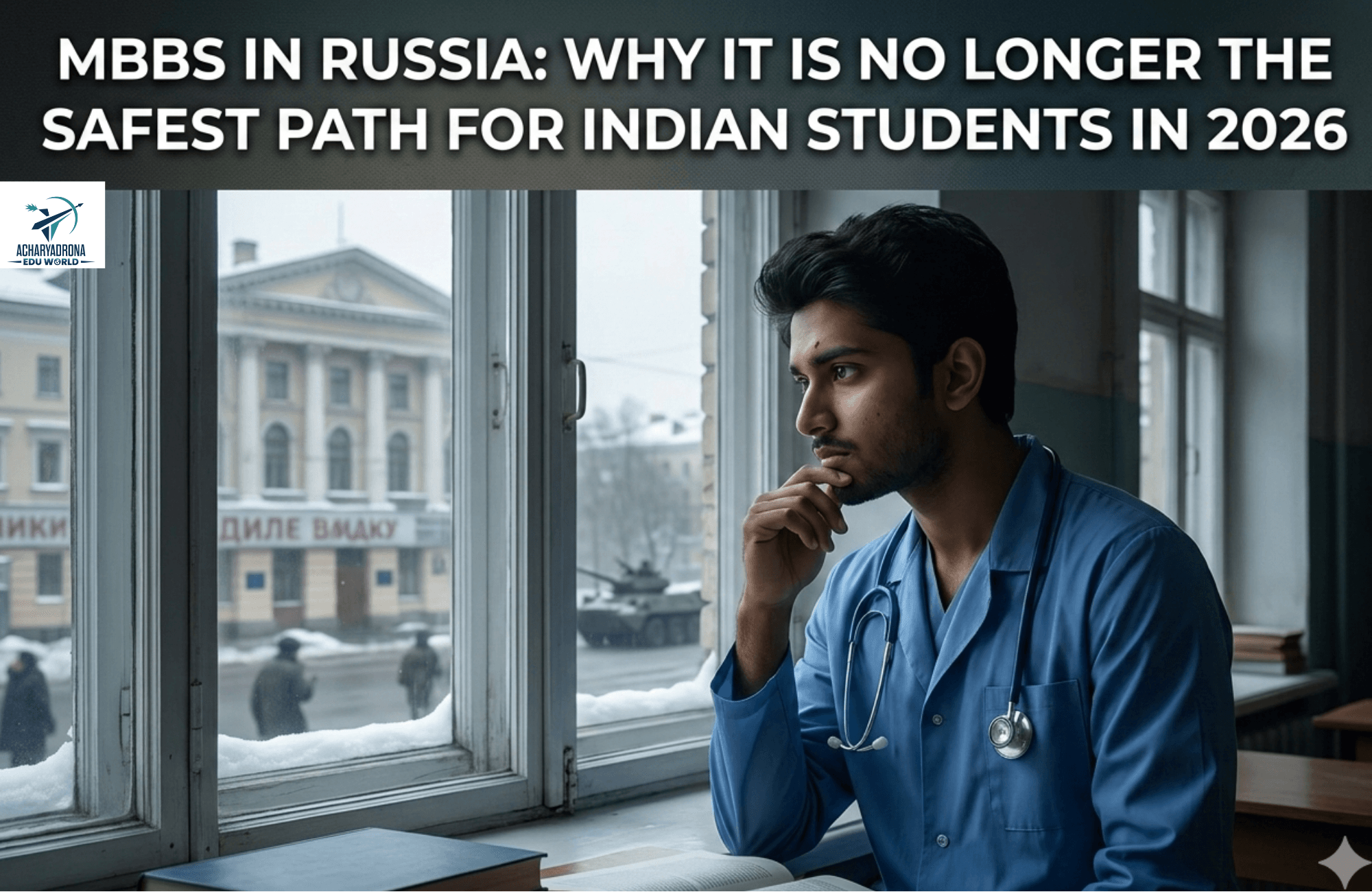
MBBS in Russia: Why it is No Longer the Safest Path for Indian Students in 2026
For decades, Russia has been a “dream destination” for Indian medical aspirants. However, as we move into the 2026 admission cycle, the landscape has fundamentally changed. At Acharyadrona Edu World, we believe in total transparency. Our mission is not just to get you an admission, but to ensure your career is built on a foundation of safety and legality.
In this strategic advisory, we break down why Russia currently presents unprecedented risks and why Central Asian neighbors like Kazakhstan and Kyrgyzstan have become the smarter, safer choices for 2026.
📞 Contact Us: 7978940093
1. Beyond the Border: The New Geopolitical Risks
Many families assume that if a university is far from the western border, it is safe. In 2026, this logic no longer holds.
Expanding Conflict Reach: With the evolution of long-range drone technology, cities once considered “deep interior” are now seeing increased military presence and security alerts.
Domestic Tension: The internal socio-political atmosphere has shifted. For an Indian student, the high level of surveillance and domestic stress can be a significant distraction from a demanding 6-year MBBS course.
The Evacuation Challenge: Unlike neutral neighboring countries, Russian airspace remains restricted. In an emergency, a rapid evacuation (like Operation Ganga) becomes exponentially more complex and expensive.
2. The Financial Gridlock: Banking & The “Agent Scam” Epidemic
The “Financial War” is perhaps the biggest hidden danger for Indian parents today.
The SWIFT Isolation: Most Russian banks are disconnected from the global grid. Sending your child’s tuition fees from an Indian bank is no longer a simple transaction—it is a gamble.
The Rise of Fee Scams: Because direct banking often fails, many parents are forced to rely on local agents to “handle the cash.” We are seeing a massive spike in fee-payment fraud, where agents collect money in India but never credit the university, leaving the student in a foreign land with unpaid dues.
Card Failure: Indian Visa and Mastercard cards simply do not work in Russia. Students are forced to carry large amounts of cash or use unstable apps, making them easy targets for financial loss or theft.
3. Logistical Hurdles & The “Visa Trap”
Getting to Russia and staying there legally has become a minefield.
Sky-High Travel Costs: With no direct flights, students must transit through hubs like Dubai or Istanbul, often paying 3x the normal ticket price.
Deportation Risk: Due to administrative delays, some agencies are sending students on Tourist or Business Visas instead of proper Student Visas. Entering on the wrong visa in 2026 leads to immediate deportation and a multi-year ban.
4. The NMC Regulation Alert: Protecting Your Degree
Your degree is only as good as its recognition in India.
The “Online Class” Trap: Due to staff shortages or safety drills, some Russian colleges have shifted to hybrid models. Remember: The National Medical Commission (NMC) of India does NOT recognize MBBS degrees earned via online classes.
Strategic Shift: While Russia faces these hurdles, countries like Kazakhstan and Kyrgyzstan have aligned their 6-year curricula perfectly with the NMC’s “54+12” month requirement, ensuring your degree is 100% valid for the NExT exam.
5. The Better Path: Why Central Asia is Winning in 2026
At Acharyadrona Edu World, we are seeing a massive shift toward Kazakhstan and Kyrgyzstan. Here is why:
Safety: They are 3,000+ KM away from the conflict zone and geopolitically neutral.
Connectivity: Direct 3.5 to 4-hour flights from Delhi mean your family is never too far away.
Financial Ease: SWIFT works perfectly. You pay the university directly from your bank. No middlemen, no scams.
Student-Centric: Modern infrastructure and a massive Indian student community make these countries feel like a “Home away from Home.”
Final Verdict from Acharyadrona Edu World
An MBBS degree is a 6-year commitment. It should be a journey of learning, not a struggle for survival or financial safety. Given the current volatility, Russia is currently a high-risk option.
We strongly advise parents and students to choose the stability of Kazakhstan or Kyrgyzstan for the 2026 intake.
Ready to make a safe choice for your medical career?
Consult with Odisha’s most trusted abroad MBBS experts today.
Visit Our Website: www.acharyadrona.com
📞 Contact Us: 7978940093
📍 Visit Us: Plot K3B/541, 1st Floor, Ghatikia Main Road, Near Saraswati Sishu Mandir, Kalinganagar, Bhubaneswar, Odisha 751003
🌐 Acharyadrona Edu World—Your Trust, Our Commitment.
FAQ:
1. Is Russia still safe for Indian students in 2026?
Russia is generally safe in many regions, but current geopolitical uncertainties have raised concerns. Students should carefully evaluate safety, travel, and long-term stability before choosing.
2. Why are students reconsidering MBBS in Russia in 2026?
Factors like war-related uncertainties, travel restrictions, and currency fluctuations are major concerns. These issues can impact education continuity and student safety.
3. Has the Russia-Ukraine conflict affected MBBS students?
Yes, the conflict has disrupted studies, travel plans, and clinical training for many students. It has also created uncertainty about long-term academic stability.
4. Are Russian MBBS degrees still valid in India?
Yes, degrees are valid if they meet the guidelines of the National Medical Commission. Students must also clear licensing exams to practice in India.
5. What are the risks of studying MBBS in Russia currently?
Risks include visa delays, limited international travel, and possible disruptions in academic schedules. Students may also face challenges in clinical exposure during uncertain times.
6. Are there better alternatives to Russia for MBBS abroad?
Yes, countries like Kazakhstan, Uzbekistan, and Georgia are becoming popular. They offer stable environments and affordable education.
7. Is NEET compulsory for MBBS in Russia?
Yes, NEET qualification is mandatory for Indian students. Without NEET, the degree will not be valid in India as per National Medical Commission.
8. Can Indian students face issues returning to India from Russia?
In uncertain situations, travel restrictions and flight availability can become problematic. This may affect vacations, emergencies, or course completion.
9. How is clinical exposure in Russian universities now?
While many universities offer good training, disruptions can occur due to external factors. This may impact hospital practice and hands-on experience.
10. Should Odisha students avoid Russia completely for MBBS?
Not necessarily, but careful research and risk assessment are important. Students should compare safer and more stable options before deciding.
11. Can I transfer from Russia to another country if issues arise?
No, as per National Medical Commission rules, transfers between universities are not allowed. This makes initial decision-making very critical.
12. What should students consider before choosing MBBS in Russia in 2026?
Students should evaluate safety, university recognition, future licensing, and geopolitical stability. Proper guidance and updated information are essential for making the right choice.