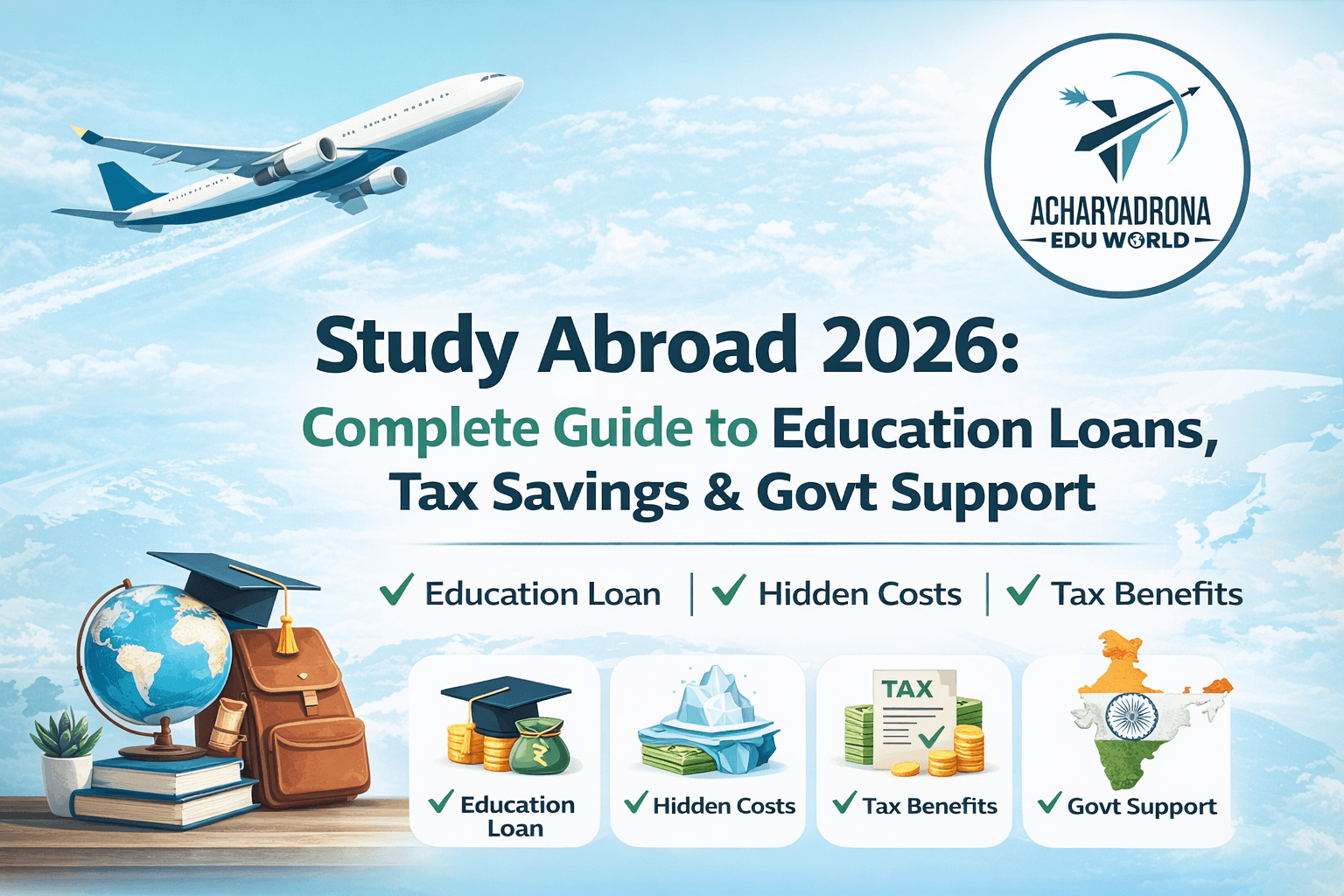
Study MBBS Abroad 2026: The Complete Guide to Education Loan, Tax Benefits & Govt Support
Studying MBBS abroad is the dream of many aspirants, a new country, experiencing different cultures, international exposure, and global career opportunities. However, it looks exciting, but the real question is – how to get admission to a globally recognized university, and how much will it really cost? Moreover, can we actually afford it?
Annual course fees, currency conversion, comparing course fees, accommodation fees, these could be too much to handle, yet crucial steps before choosing a university that adehere with nmc rules. From annual tuition fees and accommodation expenses to daily living costs and constant currency fluctuations, every factor needs careful consideration. Even a small change in exchange rates can significantly impact your overall budget. After reaching this point, most of the students back out, not because they lack ambition but because the financial path is obscure for them.
This guide tries to clear the obscurity of financial fog and explain how Acharyadrona Edu World helps them to break down the financial difficulties and how education loans actually work in 2026.
Why Education Loans Are Now the First Choice:
A few years ago, families relied heavily on savings or selling assets to fulfill their children’s MBBS abroad dream. Today, the mindset has changed. Education loans are no longer seen as a burden; they are seen as a planned investment in a global career. Most families can afford some percentage of the total cost. Remaining covered by the edu loan, which allows their children to start their mbbs carrier on time instead of delaying their future.
Beyond Tuition: The Real Cost Breakdown:
University fees are only the starting point. When you add accommodation, food, transport, and currency fluctuations, the actual expense becomes much higher than expected. Here we divided costs into sections, wise wich help to get a better understanding.
Pre-Admission Costs:
- University application fees (multiple universities = higher total)
- Entrance exams (IELTS, GRE, NEET, etc.)
- Documentation & profile evaluation
Pre-Departure Expenses:
- Visa processing charges
- Flight tickets (often expensive during peak season)
- Initial accommodation setup
Living Abroad:
- Health insurance (mandatory in many countries)
- Food, transport, utilities
- Lifestyle adjustments
Currency fluctuations. Even a small drop in the rupee can significantly increase your total cost over time. So always budget beyond the tuition fees to prevent future financial problems.
How Banks Decide: The Truth Behind Loan Approvals:
In past years, banks only saw gold or properties as collateral before sanctioning the loan. But in the current time, banks think differently; they evaluate students’ future earning potential. In simple terms, “Will this student be able to repay comfortably in the future?”
What Banks Secretly Assess:
- Reputation and ranking of the university
- Employability of your chosen course
- Job market of the destination country
- Financial stability of the co-applicant
- Credit score (CIBIL history)
That’s why students admitted to strong universities or career-focused programs often have higher approval chances even if their academic scores are average.
Loan Structure: What You Must Understand:
Most education loans come with a moratorium period—this means you don’t have to start EMI payments immediately.
- Repayment usually starts after course completion
- Some lenders add a grace period (6–12 months)
Interest keeps adding during this period. Over time, this increases your total repayment amount. Avoid this trap. Paying at least the interest during your study period can reduce the long-term burden significantly.
The Responsibility Side:
Education loans make studying abroad possible, but they also come with long-term responsibility.
- Interest rates typically range between 9% to 13%
- Repayment can extend up to 10–15 years
- Parents are usually co-applicants
- Collateral may be required for higher loan amounts
If job placement takes time after graduation, repayment pressure can increase. Although it looks like economic adversity, many students successfully overcome the situation due to proper financial planning. By researching job markets, choosing practical courses, and understanding repayment terms, one can avoid many future financial challenges.
Smart Savings: Tax Benefits & Government Support:
By understanding available tax benefits and government support schemes, students can reduce a significant part of the financial burden.
Tax Benefits on Education Loan
Under Section 80E of the Income Tax Act, students or parents can claim a deduction on the entire interest paid on an education loan.
- No upper limit on interest deduction
- Available for up to 8 years
- Applicable for studies in India and abroad
This means lower taxable income and real savings during repayment years.
TCS Benefit on Foreign Remittance
When transferring money abroad under the Liberalised Remittance Scheme (LRS):
- Using personal funds → attracts TCS (Tax Collected at Source)
- Using an education loan → significantly lower or zero TCS
This helps reduce the future financial load.
Government Interest Subsidy Schemes
Eligible students can also benefit from government schemes that reduce the interest burden:
- Padho Pardesh Scheme
It was a Government of India initiative that provided interest subsidies on education loans for students from minority communities. - Dr. Ambedkar Scheme
Provides interest subsidy for OBC/EBC students to pursue their higher education abroad.
These schemes support students during the moratorium period when repayment has not yet started.
How Acharyadrona Edu World Helps (Education Loan & Govt Schemes)
Financing MBBS abroad can be confusing, but Acharyadrona Edu World makes it simple with expert guidance at every step.
- Education Loan Support
We help you choose the right bank/NBFC, compare interest rates, and prepare strong applications for faster approval.
- Documentation Assistance
Loan rejection often happens due to small documentation errors. We guide you through the entire paperwork process, ensuring everything is accurate, complete, and submitted on time
- Government Scheme Guidance
We assist you in applying for interest subsidy schemes like Padho Pardesh and Dr. Ambedkar Scheme, helping reduce your loan burden.
- Tax & Financial Planning
We guide you on Section 80E tax benefits and help you plan your overall budget smartly.
Studying MBBS abroad is a big decision, both academically and financially. While education loans make it possible, understanding the complete cost, repayment terms, and available benefits is essential to avoid future stress. With proper planning, smart use of tax benefits, and support from government schemes, the financial burden can be managed effectively. The key is to stay informed, compare options, and plan.
With expert guidance from Acharyadrona Edu World, students can navigate loans, documentation, and financial planning with confidence.
Frequently Asked Questions (FAQs)
1. Can I get an education loan for MBBS abroad?
Yes, most banks and NBFCs in India offer education loans for MBBS abroad, provided the university is recognized, and your profile meets eligibility criteria.
2. What is the maximum loan amount for studying abroad?
Students can typically get loans ranging from ₹20 lakh up to ₹1 crore, depending on the bank, course, and collateral.
3. Do I need collateral for an education loan?
For higher loan amounts (usually above ₹7.5 lakh), banks may require collateral like property or fixed deposits. Some private lenders offer non-collateral loans based on your profile.
4. What is the interest rate on education loans in 2026?
Interest rates generally range between 8% to 13%, depending on the lender and applicant profile.
5. When do I have to start repaying the loan?
Repayment usually starts after the course ends, along with a moratorium period of 6–12 months.
6. Can I get tax benefits on an education loan?
Yes, under Section 80E, you can claim a deduction on the entire interest paid for up to 8 years.
7. Are there any government schemes for education loans?
Yes, schemes like Padho Pardesh and Dr. Ambedkar Scheme provide interest subsidies for eligible students.
8. Does my NEET score affect loan approval?
Indirectly, yes. A better NEET score can help you get admission into reputed universities, which improves loan approval chances.
9. How long does loan approval take?
It usually takes 2 to 6 weeks, depending on the bank and the completeness of the documents.
10. Can I repay the loan early?
Yes, most banks allow prepayment, and some even offer zero or minimal prepayment charges.
Contact Us:
 Call: 9114439351/6371680309
 Bhubaneswar, Odisha
Visit Our Website: www.acharyadrona.com