Real Duration of MBBS in Russia: 6 Years or 7 Years? Reality Check According to FMGL Act 2021
Russia has long been one of the most popular, culturally secure, and infrastructure-wise advanced destinations for Indian students aspiring to pursue medical education. However, if you are planning to study MBBS in Russia, the ground operational reality has completely transformed. The days of simply completing a course and returning to India are gone, thanks to the strict enforcement of the National Medical Commission’s (NMC) Foreign Medical Graduate Licensure (FMGL) Regulations 2021.
One of the biggest questions parents and students face today is: Is the MBBS duration in Russia 6 years or 7 years? Let’s dive into the reality check based on official compliance guidelines to clear up the confusion.
 Call: 9114439351/6371680309 |
The 6 vs. 7-Year Reality: Understanding Milestone 3
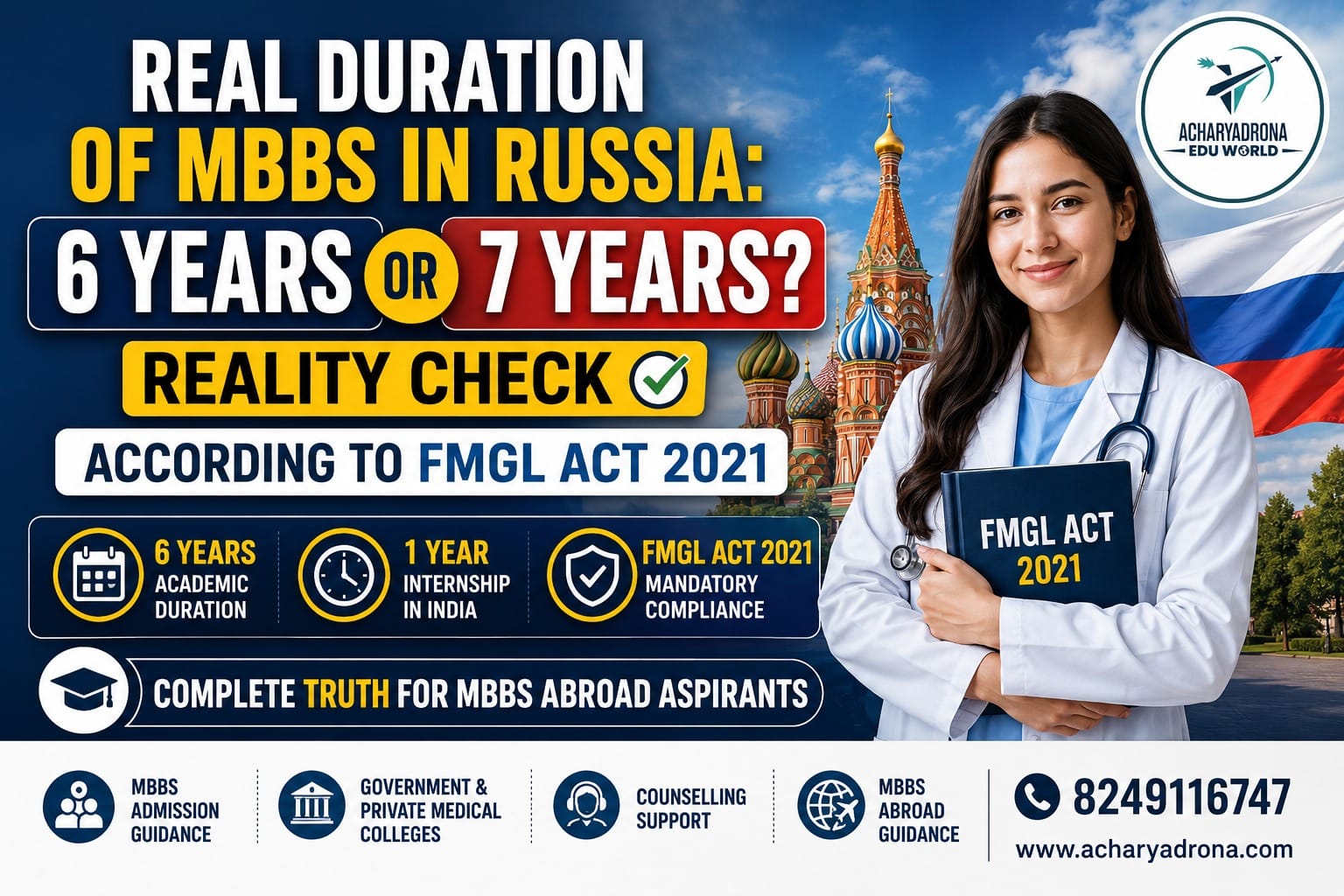
Many agents and student vloggers promote MBBS in Russia as a simple 6-year course. Technically, the academic program itself is designed for 6 years. However, the reality becomes different when the rules of the NMC FMGL Regulations 2021 are taken into account. According to these regulations, Indian students must fulfill additional mandatory requirements before becoming eligible for medical licensing in India.
-
The NMC Mandate: The NMC strictly dictates 54 months (4.5 years) of structured medical studies paired with a distinct, standalone 12-month clinical internship at the very same institution.
-
The Russian Structure Conflict: Several Russian institutions natively integrate practical clinical modules directly across their standard 6-year block. Because these practical modules are blended into the course, they do not fulfill the NMC’s requirement for a separate, unblended internship.
-
The 7th Year Extension: To meet these strict structural norms laid down by India, students studying at these universities may need to spend an extra 7th year to satisfy this separate, unblended internship provision.
Therefore, depending on how your chosen university structures its curriculum, your actual stay and study duration in Russia to be eligible to practice in India could easily extend to 7 years.
Two Other Mandatory Milestones You Must Clear
The internship duration is not the only challenge for Indian students studying MBBS abroad. To become eligible for the NEXT/FMGE licensing process in India, foreign medical graduates must also complete two important legal requirements in the country where they study. These mandatory steps are essential under current regulations and directly impact their eligibility to practice medicine in India.
1. Milestone 1: The GOZZ Exam (State Exit Exam)
This represents the ultimate final state qualification exam managed by the Russian Government. It is conducted entirely in the Russian Language. The examination consists of advanced written papers, multi station clinical simulator practicals, and a rigorous Oral Viva before an official state medical board. A degree is not issued if a student fails this component.
2. Milestone 2: State Medical Accreditation (Licensing)
Per the NMC 2021 mandate, a foreign graduate cannot register for practice in India without holding a valid unrestricted license from the native jurisdiction of study. Students must clear the Russian Government’s official licensing accreditation framework. This demands full operational command of medical terminology in the Russian language.
3. Milestone 3: The 12-Month Standalone Internship
The NMC strictly dictates 54 months of structured medical studies paired with a distinct, standalone 12-month clinical internship at the same institution. Because several Russian institutions natively integrate practical clinical modules directly across the 6-year block, students may need to spend an extra 7th year to satisfy this separate, unblended internship provision
Beware of Post-Arrival Bottlenecks & Marketing Traps
Beyond the course duration, freshman students face critical, hidden challenges right after landing:
-
The Hidden University Entrance Exam: Many agents pitch that securing a Russian Student Visa guarantees a confirmed seat. In reality, upon arrival in Russia, every student must clear a mandatory university-specific entrance examination. If a student fails to pass this evaluation, their admission is instantly rejected by the university, they are subsequently deported back to India, and they lose 1 full academic year along with non-refundable processing expenses.
-
The ‘Reel vs. Real’ Marketing Trap: Social media is currently saturated with attractive vlogs and short videos created by active Indian medical students residing in Russia. These videos present an idealized view of campus life to acquire leads. Realistically, a genuine medical curriculum demands rigour, leaving minimal personal time. Many of these student influencers operate as active sub-agents on an admission commission basis and consciously omit discussions regarding mandatory Russian-language exit exams, steep academic failure rates, or rigorous licensing protocols.
The Real Cost of Living in Russia (Monthly Budget)
To avoid sudden financial strain on families mid-course, you must budget using highly accurate breakdowns of real survival costs rather than sugar-coated figures. On average, a student requires approximately 12,000 RUB to 20,000 RUB per month (approx. ₹12,000 to ₹22,000 INR) depending heavily on the specific city tier and lifestyle choices.
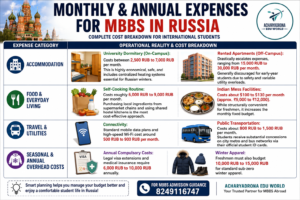
⚠️ Geographic Note: Living expenses in major metropolitan tiers like Moscow and St. Petersburg run 40% to 50% higher than regional educational hubs such as Kazan, Perm, Orel, or Bashkir.
Final Verdict: Look Before You Leap!
Do not risk a child’s future based on casual assurances, unverified trust, or sugar-coated pitches from sub-agents. If you are looking at a university in Russia, always verify how the target institution structurally transitions students from English-medium lectures into Russian medical language modules by the final years. Ask tough questions about the precise fallback procedures if a student fails the post-arrival entry text, and demand an official breakdown of local living expenses.
Understanding the reality of the 6+1 year structure (totaling 7 years) and the mandatory Russian-language licensing exams is the only way to safeguard your medical career under the NMC FMGL Regulations 2021.
Here are 15 frequently asked questions (FAQs) designed to boost your blog’s SEO ranking. They are written in a natural, deeply humanized tone that addresses the genuine anxieties of Indian parents and students while seamlessly integrating high-volume keywords related to the NMC FMGL Regulations 2021 and MBBS in Russia.
Frequently Asked Questions (FAQs)
1. What is the exact duration of MBBS in Russia for Indian students after the FMGL Act 2021?
While the core academic course in Russia spans 6 years, the actual duration to be eligible to practice in India is effectively 7 years. The National Medical Commission (NMC) mandates 54 months of medical studies along with a distinct, standalone 12-month internship at the same university. Because many Russian universities natively blend practical training into their 6-year program, students must often complete a separate, unblended 7th-year residency to meet India’s strict regulatory norms.
2. Can I study MBBS in Russia entirely in English?
Not completely. While the initial years of lectures may be taught in English, the NMC’s FMGL Regulations 2021 require you to secure a license to practice within Russia before you can sit for India’s NEXT exam. Because both the final GOZZ State Board Examination and the government accreditation process are conducted entirely in the Russian language, complete operational fluency in Russian medical terminology is mandatory by your senior years.
3. What happens if an Indian student fails the post-arrival university entrance exam in Russia?
If a student fails the mandatory post-arrival entrance evaluation, the university will instantly cancel their student status and reject their admission. Even if you hold a valid Russian student visa, failing this exam means you will be forced to repatriate back to India. This results in the tragic loss of one full academic year and all non-refundable processing fees.
4. What is the GOZZ Exam in Russia, and why is it mandatory?
The GOZZ Exam is the ultimate final State Exit Examination managed by the Russian Government. It is a rigorous, legally binding milestone consisting of written papers, multi-station clinical simulator practicals, and an Oral Viva conducted entirely in Russian. Under the NMC 2021 rules, you must pass this exam because your university will not issue a medical degree if you fail it.
5. Is a Russian medical internship valid in India under NMC rules?
A Russian internship is only valid in India if it fulfills the NMC’s requirement of being a standalone, continuous 12-month clinical rotation. If the internship is natively integrated or blended across the regular 6-year course timeline, it will fail to meet Indian structural norms. Students must ensure their university offers a separate, unblended 1-year residency.
6. Why do I need a local medical license in Russia if I plan to practice in India?
According to the NMC FMGL Regulations 2021, a foreign medical graduate is legally barred from registering or practicing in India unless they hold a valid, unrestricted medical license from the native country where they studied. Passing the Russian Government’s official licensing accreditation framework is an absolute prerequisite before you can attempt India’s NEXT / FMGE licensing pathway.
7. What is the realistic monthly cost of living for an Indian student in Russia?
On average, a student requires between 12,000 RUB to 20,000 RUB per month (approximately ₹12,000 to ₹22,000 INR) to cover basic survival expenses. However, this budget is highly sensitive to the city tier you live in and your personal lifestyle choices.
8. How much do university dormitories cost in Russia compared to rented apartments?
University dormitories (on-campus) are highly economical and safe, costing between 2,500 RUB to 7,000 RUB per month inclusive of essential centralized winter heating. Off-campus rented apartments drastically escalate expenses, ranging from 15,000 RUB to 30,000 RUB per month, and are generally discouraged for freshmen due to safety concerns and unpredictable utility charges.
9. Is it cheaper to eat at an Indian mess or self-cook while studying in Russia?
Self-cooking is the most cost-effective routine, costing roughly 6,000 RUB to 9,000 RUB per month by purchasing ingredients from local supermarket chains and using shared hostel kitchens. On the other hand, an Indian mess facility costs about $100 to $130 per month (approx. ₹9,000 to ₹12,000), which heavily inflates your fixed monthly budget.
10. Do living expenses vary significantly across different cities in Russia?
Yes, geographic location makes a massive difference. Living and maintenance expenses in major metropolitan tiers like Moscow and St. Petersburg run 40% to 50% higher than in regional educational hubs such as Kazan, Perm, Orel, or Bashkir.
11. What are the hidden or annual overhead expenses students face in Russia?
Apart from food and rent, students must budget 6,000 RUB to 10,000 RUB annually for compulsory legal visa extensions and medical insurance. Additionally, freshmen must expect a one-time winter overhead of 10,000 RUB to 15,000 RUB to buy standard, sub-zero winter apparel capable of handling Russian winters.
12. Can Indian students save money on local travel in Russia?
Yes. Standard public transportation costs around 800 RUB to 1,500 RUB per month. However, by using their official student ID cards, Indian students receive substantial concessions and discounts across the city’s metro and bus networks.
13. How much do mobile data and internet connectivity cost in Russia?
Staying connected with family back home is relatively affordable. Standard local mobile data plans and high-speed Wi-Fi networks cost around 500 RUB to 900 RUB per month.
14. Should I trust the advice of Indian student vloggers currently studying in Russia?
You should exercise severe caution. While their social media vlogs present an idealized, glamorous view of campus life to gain your trust, many of these student influencers operate as active sub-agents working on an admission commission basis. They consciously hide crucial challenges like steep academic failure rates, language-based exit exams, and rigid local licensing protocols.
15. How can I verify if a consultancy or university is genuinely compliant with NMC 2021 rules?
An authentic consultancy will never dismiss your compliance checks or sugar-coat the reality. Always demand official documentation showing how the university structurally transitions students from English lectures into Russian language modules by the final years. Directly ask them about the exact fallback and refund procedures if a student fails the post-arrival entrance test. Avoid any partner who avoids giving written proof of these parameters.
Contact Us:
Call: 9114439351/6371680309 |  Bhubaneswar, Odisha
Visit Our Website: www.acharyadrona.com
Visit Us: Plot K3B/541, 1st Floor, Ghatikia Main Road, Near Saraswati Sishu Mandir, Kalinganagar, Bhubaneswar, Odisha 751003